Generative AI vs Extraction: Document Validation
GPT-4, Claude, OCR, IDP: which technology validates business documents? Honest comparison of strengths, weaknesses, and the case for hybrid architecture.

Summarize this article with
 ChatGPT
 Claude
 Perplexity
 Gemini
 Grok
GrokGenerative AI (LLMs) cannot replace specialized OCR for financial document validation in production: numerical hallucination rates of 1-3% and non-deterministic outputs disqualify them as standalone solutions. The correct architecture combines LLMs for classification with specialized OCR for extraction and a deterministic rule engine for validation. This article provides an honest, technical comparison of both approaches and explains why hybrid architecture is the only viable path for production document validation.
No, GPT-4 Cannot Validate Your Financing Files on Its Own
LLMs hallucinate amounts in 1-3% of extractions -- a rate that is acceptable for informational summaries but disqualifying for financial validation where a single transposed digit can result in a loan disbursed against the wrong figure.
The EU AI Act (Regulation 2024/1689, Art. 6 and Annex III) classifies AI used in creditworthiness assessment and financial document processing as high-risk, mandating transparency, explainability, and deterministic audit trails that probabilistic LLMs cannot provide as standalone systems (EU AI Act, EUR-Lex).
Every quarter, a new demo goes viral: someone feeds a contract into GPT-4 and asks it to extract key terms. The model produces a clean, confident summary. The CTO forwards the video to the product team: "Can we build this?"
Here is what the demo does not show. The extracted contract amount is EUR 125,000. The actual amount on the document is EUR 152,000. The model hallucinated a transposition -- confidently, fluently, with no indication that anything was wrong. In a financing workflow, that single error could greenlight a loan against the wrong figure.
The opposite extreme is equally flawed. Legacy OCR pipelines extract characters with high fidelity but understand nothing. They will faithfully transcribe "Date of Issue: 14/02/2026" without knowing whether that date makes the document expired or irrelevant to the file at hand.
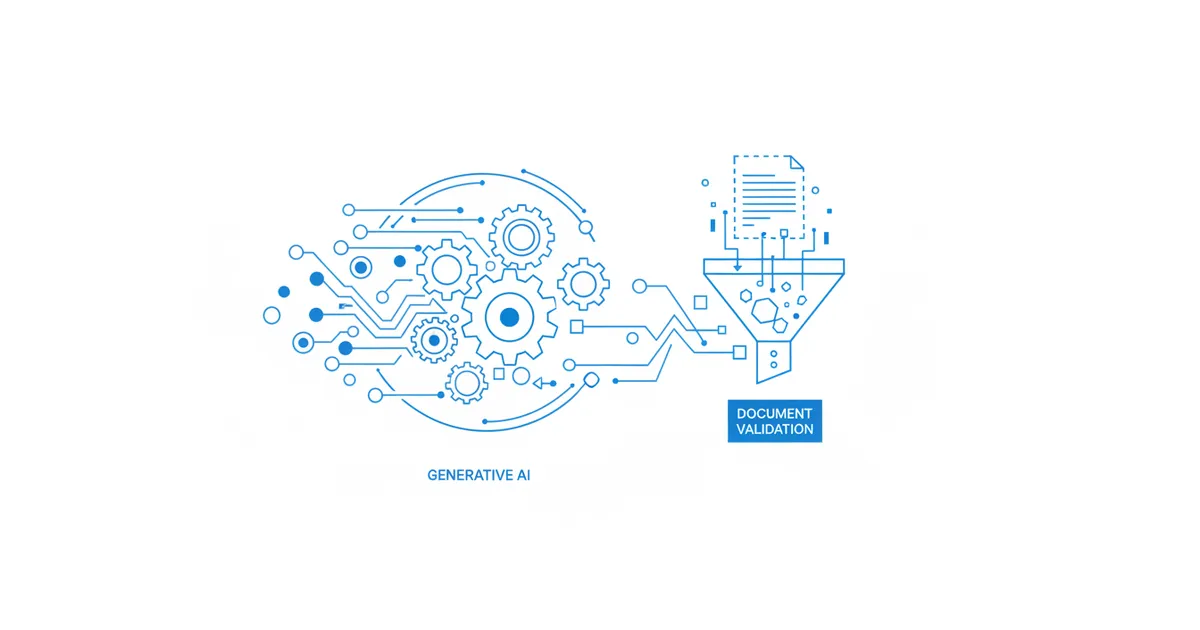
Reliable document validation requires a hybrid architecture that combines the strengths of both technologies while compensating for their structural weaknesses. This article is an honest breakdown of where each layer excels, where it fails, and how they fit together.
The 3 Technology Layers for Document Processing
The document AI landscape is not a single market. It is three distinct technology layers, each with different maturity curves, cost profiles, and failure modes.
Layer 1: OCR and Extraction Engines
These are the workhorses of document digitization. Tesseract (open source), AWS Textract, Google Document AI, and Azure AI Document Intelligence convert pixels into structured text. They excel at character-level accuracy on printed documents -- modern engines achieve 98-99% character recognition rates on clean scans. Their limitation is semantic blindness: they extract what is written without understanding what it means.
Layer 2: Classic Intelligent Document Processing (IDP)
Platforms like ABBYY Vantage, Kofax, and Hyperscience add a classification and field-extraction layer on top of OCR. They use supervised machine learning models trained on specific document types to locate and extract predefined fields (invoice number, total amount, due date). They represent the current enterprise standard -- reliable, auditable, but rigid. Adding a new document type or field requires retraining, and they struggle with unstructured or freeform content.
Layer 3: Generative AI (LLMs with Vision)
GPT-4V, Claude, Gemini -- large language models with vision capabilities that can read, interpret, and reason about documents. They bring something genuinely new to the stack: contextual understanding. They can classify a document they have never seen before, answer questions about its content, and identify inconsistencies in natural language. Their limitation is the inverse of OCR: they understand meaning but cannot guarantee precision on specific values.
What Generative AI Does Well
Generative AI excels at document classification (above 97% accuracy across diverse document types) and contextual understanding -- capabilities that were genuinely impossible with traditional NLP two years ago.
According to the EBA's 2024 Annual Report, approximately 10% of EU banks are already testing General-Purpose AI for AML/CFT use cases including client profiling and document classification -- confirming that LLMs have a legitimate role in the compliance stack when deployed appropriately (EBA Annual Report 2024).
| Task | Performance | Why It Works |
|---|---|---|
| Document classification | Excellent (>97% on diverse types) | LLMs generalize from context; no per-type training needed |
| Context understanding | Excellent | Semantic reasoning is what transformers were built for |
| Unstructured field extraction | Good (85-92%) | Handles freeform layouts, handwritten notes, atypical formats |
| Question answering on documents | Excellent | Natural language interface to document content |
| Anomaly detection (visual) | Good | Can flag unusual layouts, missing sections, visual inconsistencies |
| Multilingual processing | Excellent | Single model handles 50+ languages without configuration |
For use cases like mailroom triage or generating human-readable summaries, generative AI is a genuine step change. A single prompt can replace months of rule-writing for classification alone.
What Generative AI Does Poorly
This is the section that matters most. If you are evaluating generative AI for production document validation, these limitations are not edge cases -- they are structural constraints of the technology.
Precise Amount Extraction: Hallucinations Are Not Bugs, They Are Features
LLMs are probabilistic text generators. When extracting "EUR 1,250.00" from a scanned invoice, the model is not reading the number -- it is predicting the most likely token sequence given the surrounding context. This means:
- Digit transposition: EUR 1,250 becomes EUR 1,520. The model has no mechanism to verify it reproduced the exact characters.
- Rounding and approximation: EUR 14,873.42 becomes EUR 14,900. The model favors "round" numbers that are statistically more common in its training data.
- Currency confusion: In multilingual documents, $ and EUR can be silently swapped.
For informational extraction (summarizing a report), a 2% error rate on amounts may be acceptable. For financial validation (does the loan amount match the agreement?), it is disqualifying.
Arithmetic Verification: LLMs Predict, They Do Not Calculate
Ask GPT-4 whether the line items on an invoice sum to the stated total. It will give you an answer. That answer will be wrong roughly 15-20% of the time on invoices with more than 10 line items. LLMs do not perform arithmetic. They predict what the answer "should look like" based on pattern matching. This is a fundamental architectural limitation, not a solvable bug.
Cross-document arithmetic -- verifying that disbursement amounts across three contracts sum to the facility total -- is even less reliable. The error compounds with each additional document.
Cross-Document Consistency: Not Designed for N-Document Comparison
A financing file might contain 8-15 documents. The company name on the registration certificate must match the bank details. The director listed on the articles of incorporation must match the signatory on the guarantee. The financial figures in the balance sheet must align with the tax return.
LLMs process documents sequentially or in limited context windows. They are not architecturally designed to maintain a structured state across N documents and verify pairwise consistency. They can be prompted to attempt this, but reliability drops sharply as the number of cross-references increases.
Reproducibility: Same Document, Different Results
Run the same document through an LLM extraction pipeline ten times. You will get slightly different results each time -- field formatting variations, different confidence phrasings, occasionally different values. This is inherent to probabilistic generation. Temperature settings help but do not eliminate variance entirely.
For audit trails, this is a problem. Regulators expect deterministic outcomes: the same input must produce the same output. A validation decision that changes between Tuesday and Wednesday, with no change to the underlying document, is not auditable.
Auditability: Post-Hoc Explanation Is Not Deterministic Logic
When an LLM rejects a document, it can explain why in fluent natural language. But that explanation is generated after the decision, not derived from it. The model does not apply Rule 4.2.1 of your compliance policy -- it produces text that resembles what such an application might look like.
In regulated industries (banking, insurance, leasing), audit teams need to trace every decision to a specific rule. "The AI said so" is not a compliance-grade justification, regardless of how articulate the explanation is. The EU AI Act (Regulation 2024/1689) reinforces this requirement by mandating transparency and explainability for high-risk AI systems, which includes AI used in creditworthiness assessment and financial document processing.
The Business Rule Engine: The Missing Piece
Deterministic business logic -- the layer that neither OCR nor generative AI provides -- is the backbone of every compliant document validation process. Without it, "validation" is approximation.
The FATF Recommendation 10 on Customer Due Diligence requires that verification measures be applied consistently and systematically across all customers -- a standard that demands deterministic rule engines, not probabilistic AI outputs that vary between runs on the same document (FATF Recommendations).
Consider a simple validation rule for equipment financing:
The financed amount on the leasing contract must equal the amount on the supplier quote, with a tolerance of EUR 1.
This rule has three properties that matter:
- It is deterministic. Given the same inputs, it always produces the same output.
- It is auditable. The decision can be traced to a specific rule with specific thresholds.
- It is configurable. The EUR 1 tolerance can be changed to EUR 0 or EUR 10 without retraining a model.
An LLM cannot guarantee any of these properties. It can approximate the rule ("the amounts look consistent"), but approximation is not validation. When regulators audit your process, "the amounts look consistent" is not equivalent to "Contract Amount (EUR 45,230.00) = Quote Amount (EUR 45,230.00), delta EUR 0.00, within tolerance of EUR 1.00."
Business rules are unglamorous. They are IF/THEN statements, threshold comparisons, regex validations, date arithmetic. But they are the backbone of every compliant document validation process. No amount of generative AI sophistication replaces the need for a rule engine that executes deterministic logic on extracted data.
The Hybrid Architecture: How the Pieces Fit Together
The correct architecture combines four complementary layers: generative AI for classification, specialized OCR for precision extraction, a deterministic rule engine for validation, and external APIs for cross-referencing against official registries.
The EU AI Act (Regulation 2024/1689, Art. 13) mandates that high-risk AI systems used in financial processing provide transparency and traceable decision-making -- requirements that hybrid architectures satisfy through their deterministic rule engine layer, while pure LLM approaches cannot (EU AI Act, EUR-Lex).
Document Input
      |
[LAYER 1: Generative AI] — Classification, layout understanding, anomaly screening
      |
[LAYER 2: Specialized OCR] — Field-level extraction, character-accurate data
      |
[LAYER 3: Rule Engine] — Cross-document checks, arithmetic, thresholds, regulations
      |
[LAYER 4: External APIs] — Registry lookup, sanctions check, database verification
      |
   Decision (Accept / Review / Reject)
Layer 1 (Generative AI) handles what requires understanding: classifying document types, interpreting non-standard layouts, flagging anomalies. Layer 2 (Specialized OCR) handles what requires precision: extracting exact amounts, dates, and registration numbers. Layer 3 (Rule Engine) handles what requires determinism: verifying that extracted values satisfy business and regulatory rules. Layer 4 (External APIs) handles what requires external truth: confirming company existence in official registries and checking sanctions lists.
Each layer is independently testable, auditable, and replaceable. If a better OCR engine emerges, you swap Layer 2 without touching the rule engine. If regulations change, you update Layer 3 without retraining any AI model.
Final Comparison: Four Approaches to Document Validation
| Criterion | OCR Alone | Classic IDP | LLM Alone | Hybrid Architecture |
|---|---|---|---|---|
| Extraction accuracy (amounts, dates) | High (98%+) | High (96-99%) | Moderate (80-92%) | Very High (99%+) |
| Document understanding | None | Limited (trained types only) | Excellent | Excellent |
| Cross-document validation | None | Basic (predefined rules) | Unreliable | Comprehensive |
| Auditability | Full (deterministic) | Full (deterministic) | Low (probabilistic) | Full (rule engine layer) |
| Adaptability to new document types | Requires development | Requires retraining (weeks) | Immediate (zero-shot) | Fast (days) |
| Regulatory compliance readiness | Partial (extraction only) | Good | Insufficient alone | Complete |
The pattern is clear. No single technology column satisfies all six criteria. Only the hybrid approach achieves "very high" or "complete" across the board. This is not a marketing conclusion -- it is an architectural reality.
The Cost of Getting This Wrong
LLM-only approach: A fintech builds validation entirely on GPT-4V. In production, 3% of extracted amounts contain errors -- 300 files per month with incorrect financial data on a 10,000-file volume. The first regulatory audit flags the non-deterministic decision trail. Remediation costs six months of engineering.
OCR-only approach: A leasing company deploys Textract. Extraction is accurate, but every new document type requires weeks of development. The operations team maintains a parallel manual process for "exceptions" that account for 30% of volume.
Hybrid approach: Classification adapts instantly to new document types. Extraction is character-accurate. Validation is deterministic and auditable. When regulators ask "why was this file approved?", the answer traces to specific rules applied to specific extracted values.
The convergence is already underway. OCR vendors are adding LLM-powered classification. LLM providers are adding structured extraction modes. Within 18 months, the market will largely consolidate around hybrid architectures -- not because it is trendy, but because no single technology layer satisfies accuracy, auditability, and adaptability requirements simultaneously.
Frequently Asked Questions
Can I use ChatGPT or Claude to validate documents in production?
Not as a standalone solution. LLMs excel at classification and contextual understanding, but they hallucinate on amounts (1-3% numerical error rate) and do not guarantee reproducible results. Reliable validation requires combining an LLM with specialized OCR and a deterministic rule engine.
What is a hybrid architecture for document validation?
It is a processing pipeline that orchestrates four complementary layers: generative AI for classification and understanding, specialized OCR for precise numerical extraction, a business rule engine for deterministic checks, and external APIs for cross-referencing against official databases. Each layer compensates for the weaknesses of the others.
Why can't LLMs replace business rule engines?
An LLM predicts the most probable result; a rule engine executes deterministic logic. For critical checks (contract amount = agreement amount, registration certificate under 3 months old, consistent company numbers across documents), only a rule engine guarantees the reproducibility and auditability that regulators demand.
How accurate is a hybrid architecture compared to an LLM alone?
Hybrid architecture achieves over 99% numerical extraction accuracy, versus 80-92% for an LLM alone. For cross-document verification, the gap is even wider: LLMs become unreliable beyond 3-4 documents, while hybrid architecture handles files with 15+ documents consistently.
CheckFile: Built Hybrid from Day One
CheckFile was not built as an OCR tool that added AI, or as an LLM wrapper that added extraction. It was designed from the ground up as a hybrid architecture: generative AI for classification and understanding, specialized extraction for precision, a deterministic rule engine for validation, and external API integration for enrichment.
The result is a platform that classifies documents it has never seen, extracts amounts to the cent, validates business rules to the letter, and produces audit trails that regulators accept. No hallucinated amounts. No non-deterministic decisions. No "the AI said so" justifications.
If you are evaluating document validation technology, start with the architecture question -- not the vendor question. Once you understand that hybrid is the only viable approach for production use, the vendor comparison becomes straightforward.
Explore our document validation platform or review our pricing to see how hybrid architecture translates into concrete performance on your document types.
Related reading: see how hybrid architecture applies in practice in our article on cross-document validation beyond OCR, or quantify the business case in our analysis of the true cost of manual document validation.