
Guide
Edited Utility Bill: Name and Address Cross-Checks
How to spot an edited utility bill with a changed name or address: the fields to compare against the ID, bank statement and supplier data, and what to do on a mismatch.
9 min read
How to spot an edited utility bill with a changed name or address: the fields to compare against the ID, bank statement and supplier data, and what to do on a mismatch.

How to run a company registration number check across supplier documents: which field on which document is compared with which register, what a mismatch looks like, and what to do next.

Income verification documents only help when they agree. Compare payslip, P60, SA302 and bank statement field by field, and know what to do on a mismatch.

Address matching verification across documents: how to compare formats, abbreviations and flat numbers on an ID, bill and statement, and what to do on a mismatch.

Cross-document verification compares the same field across documents and registers. See the seven checks, what a mismatch looks like and the reviewer's next step.

Name matching documents: how to compare a name on an ID with a payslip or bank statement when accents, maiden names, compound names and transliteration differ.

Document tampering often means a real payslip, bank statement or certificate with only the name and date swapped. Learn the patterns, checks and UK legal context.

How to tell whether a signed PDF was edited after signing: read the signature panel, compare signed revisions, spot shadow attacks and decide what to ask the sender.

Online PDF editor traces explained: the producer string, rewritten structure, re-embedded fonts and lost signatures that web editors leave in a document you receive.

How to spot an altered bank statement: recompute the running balance line by line, check opening and closing balances, and know what the arithmetic cannot prove.

Edited payslip detection guide: the amount, date and name inconsistencies to check, and the cross-document comparisons that confirm or clear a suspicious payslip.

How to tell if a PDF has been edited: a 7-step check of properties, revisions, signatures, fonts and cross-document data that reviewers can run in 10 minutes.
Document scan quality requirements explained: what makes a scan, photo or PDF readable, and a request, rescan or manual review decision table for blur, cropping and locked files.

Double JPEG compression analysis exposes composites and re-scans that error level analysis misses. A technical guide for compliance teams in 2026.

Learn to spot AI-generated fake documents through texture, lighting and MRZ mismatch artifacts — a forensic technique compliance and fraud teams can act on.

Adversarial attacks try to fool AI models that screen documents for fraud. How the attacks work, what UK and EU rules require, and why layered detection resists them.

C2PA, Content Credentials and AI watermarking explain what they miss for document fraud, why they fail, and which detection layers actually catch forged files.

Fabricated, tampered or reused certificates of completion: how to verify an e-signature audit trail against the underlying cryptographic seal instead of trusting the PDF.

How to detect an edited photo: why human visual review misses skilled edits, and the forensic signals — ELA, EXIF, clone patterns — that actually work.

No camera, no real product, no reuse to catch in a reverse search: how fully AI-generated damage photos differ from edited ones, and the signals that expose them.

Clone artifacts, localized error levels, EXIF traces, inconsistent shadows: the forensic signals that expose a fake damage photo used in a return, warranty, or claim.

A genuine damage photo obeys precise physical constraints on light, angle and framing. Here are the signals claims handlers learn to read before approving a payout.

What EXIF timestamps and GPS geolocation on a photo actually prove in a refund dispute, how to verify them, and why they remain trivially fakeable.

Which photos should support agents require before refunding a claim? Full checklist, UK consumer law and the fraud signals that make photos unreliable alone.

Reverse image search catches recycled claim photos pulled from the web. Here is exactly where it fails, and what closes the remaining gap.

A screenshot of a photo discards the original camera's metadata, breaking the chain of custody insurers, KYC teams and courts rely on. What gets lost, and what to request instead.

The same damage photo sometimes surfaces across several insurance claims. How perceptual hashing, regulatory limits and triage workflows catch recycled evidence in 2026.

What EXIF metadata actually proves about a customer photo, and where its evidential value stops — court rulings, technical limits and 2026 best practice.

How to structure high-volume claim photo review: AI produces actionable signals, adjusters decide. Method, FCA expectations and 2026 workflow design.

In-app camera capture blocks image reuse and screen recapture but not video injection. Compare the fraud trade-offs against file upload for KYC document checks.

How to require, verify and challenge photo evidence in e-commerce claims: UK consumer law, a collection checklist, and the signals that reveal a manipulated photo.

Screen recapture attacks let fraudsters bypass KYC document uploads by photographing a screen. Forensic signals — moiré patterns, PAD vs IAD — expose them.

Traced signatures, digital montage, AI-generated handwriting: the visual signals and forensic techniques that expose a forged signature on a scanned document in 2026.

Fraudsters hide instructions, not just fake data, inside documents to hijack AI KYC checks. Learn how prompt injection works and how to defend pipelines.

How to use EXIF metadata forensics to spot falsified payslip, bank statement, and ID photos submitted during KYC onboarding — red flags, tools, and limits.

Learn how to spot fake holograms and forged security features on ID documents — practical checks compliance teams can run before AI-assisted fraud slips through.

Fraudsters exploit the gap between a PDF's visible image and its hidden text layer to fool OCR checks. Learn how cross-checking both layers catches it.
Use this fake payment screenshot detector guide to spot forged bank, PayPal, Venmo and Revolut proofs before you release goods or keys.

A photographed stamp can be copied and pasted in seconds. Here are the 7 visual red flags and forensic techniques that expose a forged stamp on a document.

Recycled fraud documents pass single-file checks but repeat across applications. Learn how document fingerprinting exposes fraud rings reusing the same template.

How to verify the QR code or barcode on an official document to detect a forgery, comparing 2D-Doc, MRZ, PDF417, and EUDI Wallet verification standards.

Font forensics detects forged documents through typeface substitution, kerning errors, and anachronistic fonts, distinct from ELA and metadata checks.

12 concrete signals — metadata, text patterns, visual cues, and cross-checks — to identify AI-generated or AI-altered documents. Practical guide for compliance and KYC teams.

ChatGPT and large language models now generate undetectable fake text documents. How fraudsters exploit LLMs, which documents are targeted, and how to protect your organisation.

Generative AI models (GANs, diffusion, LLMs) fabricate payslips, IDs and bank statements that fool the human eye. Learn how they work and what detection methods actually stop them in 2026.

Liveness detection and document forgery detection protect against different fraud vectors. Learn their differences, regulatory requirements, and how to combine them in KYC.

Error level analysis (ELA) detects pixel-level manipulation in JPEG images. Learn how forensic teams use ELA to uncover forged payslips, IDs, and bank statements.

Find modification traces in a PDF: metadata forensics, tools and red flags to check if a PDF was edited, plus UK compliance steps.

Practical guide to training staff on visual cues for AI-generated document fraud: seven key indicators, a three-tier programme, and UK AML obligations for 2025.

How to detect fraudulent proof of address, bank details, and tenancy agreements during home insurance underwriting in 2026. FCA framework, detection methods, and tools.

Compare document forensics tools for detecting AI manipulation in PDFs and images. Practical 2026 guide with comparison table and selection criteria for UK businesses.

Complete guide to deepfake document detection: techniques, tools, and regulatory requirements for spotting synthetic ID forgeries in 2026.

How finance teams can use fake invoice detection AI to identify AI-generated invoices in 2026. Covers red flags, a 5-step protocol, and UK regulatory context.

AI-generated identity fraud, synthetic payslips, deepfake documents: a guide to the types, forensic detection methods, and regulatory outlook for 2026.

How much does CheckFile cost? Starter, Business and Enterprise plans explained, pay-per-use model, and ROI analysis for automated document verification.

Detailed comparison of CheckFile vs Veriff — features, pricing, accuracy, compliance. Which identity verification solution should you choose in 2026?
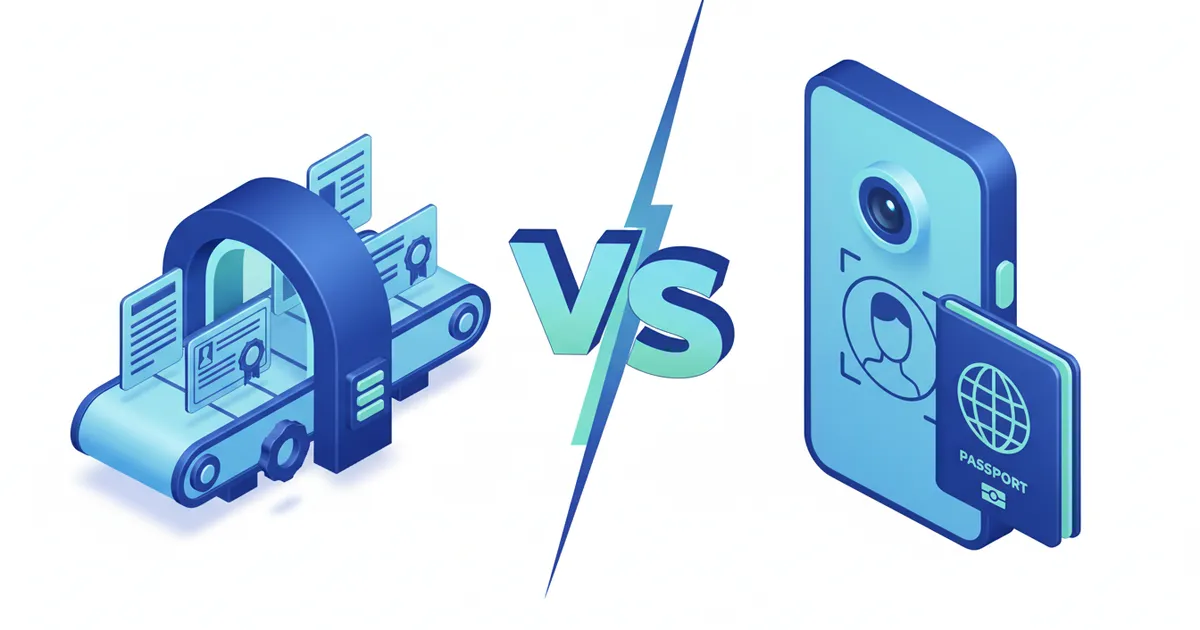
Detailed comparison of CheckFile vs Jumio — features, pricing, accuracy, compliance. Discover which document verification solution to choose in 2026.

Detailed comparison of CheckFile vs Sumsub — features, pricing, accuracy, compliance. Discover which document verification solution to choose in 2026.
Detailed CheckFile vs Onfido comparison — features, pricing, OCR accuracy, FCA compliance. Which document verification solution to choose in 2026?

Complete KYS guide for procurement teams: 12-step vendor verification checklist, UK/EU regulatory requirements (MLR 2017, Modern Slavery Act), red flags, and automation.

Step-by-step guide to verifying business licenses and permits online in the UK. Companies House, FCA Register, VAT validation, sector-specific permits, and automation tools.

Use this vendor and supplier due diligence checklist: 7-step assessment, FCA and MLR 2017 duties, third-party risk categories and automation.

Which UK utility bills count as proof of address? Accepted documents, fraud signals, FCA and MLR 2017 rules, and automated KYC checks.

Compare age verification systems and services: how methods work, plus Ofcom and Online Safety Act 2023 duties and penalties for providers.

Verify work history, proof of employment and credentials: legal requirements, document checklist and automation options for employers.

A practical guide to background check documentation for UK employers: right to work, DBS checks, employment history, qualifications, and GDPR compliance.

Detailed comparison of CheckFile vs Trulioo — features, pricing, global network, compliance. Which identity verification solution should you choose in 2026?

Complete guide to document verification pricing: pricing models, hidden costs, ROI calculation and vendor negotiation strategies.

Complete guide to global data privacy compliance: GDPR, CCPA, LGPD, POPIA, PIPL, DPDPA.

Complete guide to electronic document archiving in the UK: legal obligations, retention periods, technical standards
Technical and compliance evaluation framework for choosing your document verification solution: 15 criteria, scoring grid and selection process.

KYC solution pricing breakdown with ROI calculator and TCO analysis. Compare manual vs automated costs per check and calculate your 3-year savings.

Compare identity verification solutions by method, pricing and compliance level. A decision framework for KYC teams choosing document-based tools.
Comparison of the best document verification software in 2026: features, pricing, compliance and selection criteria for your business.

Detailed comparison of CheckFile vs IDology — features, pricing, geographic coverage, compliance. Which verification solution should you choose in 2026?

Practical anti-fraud framework for document processing teams. Covers fraud typologies, internal controls, staff training

UK e-invoicing regulations explained: Making Tax Digital, HMRC digital records, Peppol adoption and VAT Act 1994 steps for compliance.

Automated document verification workflows reduce processing time by 85% and error rates by 92%.

UK document retention requirements by industry. Statutory periods under the Companies Act 2006, Limitation Act 1980
Document verification: checklists, AI solution selection, API integration and digital identity. Practical 2026 guide for compliance professionals.

What is KYB? Business verification process, required documents (certificate of incorporation, PSC register) and Companies House checks.

Complete guide to customer onboarding best practices: balancing KYC/AML compliance with user experience, risk-based approach
KYC requirements for banks vs fintechs compared: FCA licensing, PSD2, UK MLR 2017 obligations, compliance processes and technology differences explained.

Customer due diligence checklist by sector: banking, real estate, legal, accounting. SDD, CDD and EDD levels with FCA guidance.

France Identité generates QR-verified, single-use identity proofs. How this government app transforms KYC, rental checks, and document workflows.

Integrate document validation into your application: REST API, webhooks, code examples in Python and Node.js.

Required documents by financial partner: GRENKE, SIEMENS, LEASECOM, REALEASE. 23% of file rejections are avoidable with the right checklist.

Complete buyer's guide for AI document validation: 8 evaluation criteria, comparison framework, key questions for vendors, and common mistakes to avoid.