Food supplier certificate verification: cross-checking USDA organic, IFS and BRCGS before listing
How US buyers verify a food supplier's USDA organic, IFS and BRCGS certificates before approval: fields to compare with the USDA Organic Integrity Database, the BRCGS Directory and state business records, and what to do on a mismatch.

Summarize this article with
 ChatGPT
 Claude
 Perplexity
 Gemini
 Grok
This article is for information only and is not legal or food-safety advice. Regulatory references are accurate as of publication (November 26, 2026). Check current federal and state rules and the scheme owners' terms before applying them to a specific supplier file.
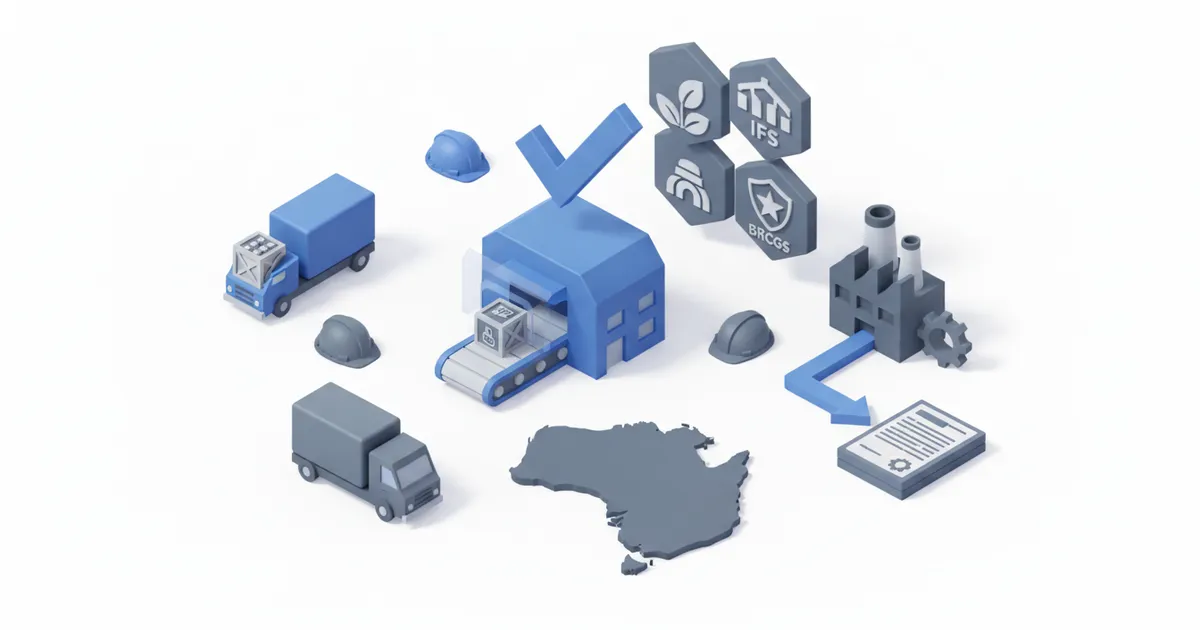
Verifying a food supplier's certificates in the United States means comparing the PDF with the issuing database, then comparing both with the legal entity, facility and products on your purchase order. A USDA organic certificate, an IFS Food certificate and a BRCGS certificate can each be genuine and still not cover your supplier, your facility or your item. This guide covers the fields to compare, the register for each, what a mismatch looks like and the reviewer's next step.
What does each certificate prove, and what does it not?
Each certificate proves one narrow thing: a named operation or site was assessed against one standard, for one scope, by one body, for one period. None proves that the lot on your dock is compliant.
| Certificate | Owner | Proves | Does not prove |
|---|---|---|---|
| USDA organic certificate of organic operation | USDA National Organic Program (NOP); accredited certifying agent | Operation certified for listed scopes (crops, livestock, processing, handling) | That each lot is organic; nothing about facility food safety |
| IFS Food | IFS Management GmbH; certification body | Site audited against IFS Food for a stated scope | That the entity invoicing you is the audited one |
| BRCGS Food Safety | BRCGS; certification body | Site audited, with grade, scope and expiry | That the grade still stands if the certificate was suspended after the PDF was sent |
A certificate is evidence about a facility and a scope. Your approval decision depends on whether it is the right facility and the right scope.
Cross-check 1: USDA organic certificate against the Organic Integrity Database
Compare operation name, address, OID ID number, certified scopes, certifying agent and effective dates on the certificate with the operation's profile in the Organic Integrity Database (OID). Under 7 CFR 205.404, the certificate of organic operation must be generated from the OID and must include the operation's OID ID number and a link to the database or the operation's profile, with a statement that readers can verify certification there. USDA's Strengthening Organic Enforcement final rule says OID-generated certificates simplify verification.
In practice, open the OID at organic.ams.usda.gov/integrity, run an advanced search with the program set to USDA NOP, and confirm the status, scopes and certifier. The OID also lists suspended and revoked operations, and certifier profiles link to accreditation documents. USDA's page on fraudulent organic certificates is a useful reference for what altered certificates look like. The OID proves a status for a named operation. It does not prove that the PDF in your inbox is unaltered; if the PDF has no OID ID number or link, treat it as non-compliant with 205.404 and ask for the current certificate.
Imported organic products add a second check: importers must be certified under the NOP too, so compare the importer on the paperwork with its own OID profile, not only the foreign producer's.
Cross-check 2: IFS and BRCGS against the scheme owner's database
Confirm status with the scheme owner or certification body, not from the copy the supplier emailed. BRCGS guidance treats photocopies as insufficient on their own as validation.
The BRCGS Directory site search requires a login; a free account lets you look up a currently certificated site and see site code, grade, scope and expiry. Search by site name or the 6 or 7-digit site code. Certification bodies typically update it within 24 hours of a decision, and the owner may restrict the certificate PDF (BRCGS Verify FAQs).
For IFS, the IFS database page describes a tool to verify certificates and letters of confirmation, with access that depends on your role. Each IFS certificate also has a QR code generated by IFS Management GmbH to check authenticity and validity (SQS).
| Field | Supplier's PDF | Register | Mismatch means |
|---|---|---|---|
| Site code (BRCGS code, IFS COID) / OID ID | Printed | Same code | Wrong site or typo; stop |
| Name and address | Printed | Register entry | Different plant from the shipper |
| Scope / categories | Printed | Register scope | Your item is outside scope |
| Grade / status | Printed | Register | Altered or outdated PDF |
| Expiry | Printed | Register expiry | Lapsed, suspended or edited date |
| Certifier | Printed | Register | Unrecognized or mismatched body |
Ready to automate your checks?
Free pilot with your own documents. Results in 48h.
Request a free pilotCross-check 3: certificates against the legal entity and the shipment
The common gap is a genuine certificate that belongs to a different entity or facility. Parent companies, brokers and co-packers share names. A broker not named on the certificate, or a supplier shipping from a second plant, gets approved under a certificate it does not hold.
Compare these pairs before approval:
- Legal name on the certificate versus the state business entity record (Secretary of State) and the W-9. The EIN and name on the W-9 should match the invoicing entity. See our supplier registration number check.
- Certified facility address versus ship-from address on the purchase order and bill of lading.
- Certificate scope versus items purchased. A BRCGS scope for ambient ready meals does not cover chilled dairy made at the same address.
- Validity versus delivery date. Auditors check validity on the day you bought, not only on review day.
- Organic scopes versus invoice lines. Each line labeled organic should fall within a certified scope.
- Certifier on the PDF versus the register. If they differ, the PDF is not the current certificate.
Under FDA's preventive controls rule, a receiving facility must have a supply-chain program with supplier approval and verification where a hazard is controlled by the supplier (21 CFR Part 117, Subpart G). A certificate check is one input to that program; it does not replace the program's own documented verification activities.
What does a mismatch look like, and what does the reviewer do?
Classify the mismatch, then act on the class: correctable, blocking or escalate.
| Mismatch | Likely cause | Reviewer action |
|---|---|---|
| PDF expiry later than register | Edited date or replaced certificate | Block; request current certificate and confirm with certifier |
| Not found in register | Wrong code, suspended or not certified | Hold approval; request site code and certifier contact |
| Name differs, same address | Rebrand or affiliate | Request name-change documentation or state record |
| Scope excludes your item | Scope gap | Approve covered items only, or require extension |
| Register shows suspended or revoked | Failed audit or enforcement | Do not approve; log date and reviewer |
| Valid certificate, different ship-from site | Second plant | Request that site's certificate |
Log who checked which register on which date and keep a screenshot or export.
What do buyers ask on food-safety forums?
Practitioners keep asking the same things. Is there a public database of IFS-certified companies? Access depends on your role, so the certificate's QR code and the certifier's directory are the practical routes. What if a supplier's certificate lapsed before our audit? Keep invoices and receiving records showing what was bought when, and re-verify at each renewal. Is a scan enough? It is a lead, not proof.
How often should you re-check?
Re-check before approval, at each expiry (IFS Food certificates run 12 months) and when a shipment arrives from a new site or product line. Our guide to supplier certificate expiry tracking covers the calendar, the supplier onboarding documents checklist covers the rest of the file, and the industry verification guide covers other sectors.
Where does CheckFile fit?
CheckFile compares fields extracted from each supplier document: names, addresses, registration numbers, dates and scopes across the certificate, the entity record and the purchasing documents. It flags where they disagree and where a date has passed; it does not certify that a document is authentic, and register lookups remain a reviewer step. See pricing, our security approach or the homepage.
Frequently asked questions
How do I verify a USDA organic certificate?
Search the operation in the USDA Organic Integrity Database and compare status, scopes and certifier with the certificate. A compliant certificate carries the OID ID number and a link to the database.
Can I verify a BRCGS certificate for free?
Yes, with a free Directory account you can search currently certificated sites and see grade, scope and expiry. PDFs may be restricted by the certificate owner.
Does an organic certificate prove my shipment is organic?
No. It shows the operation is certified for certain scopes. Check that invoice lines fall within those scopes and, for imports, that the importer is itself certified.
Is a valid certificate enough to approve a supplier?
Only if the certified entity, facility and scope match your supplier, ship-from address and items. Otherwise the valid certificate is about someone else.
Stay informed
Get our compliance insights and practical guides delivered to your inbox.