Training provider learner documents: cross-checking student files for funded courses
Training provider learner documents compared field by field in Australia: ID, USI, enrolment, attendance and invoices. What a mismatch looks like and what the reviewer does next.

Summarize this article with
 ChatGPT
 Claude
 Perplexity
 Gemini
 Grok
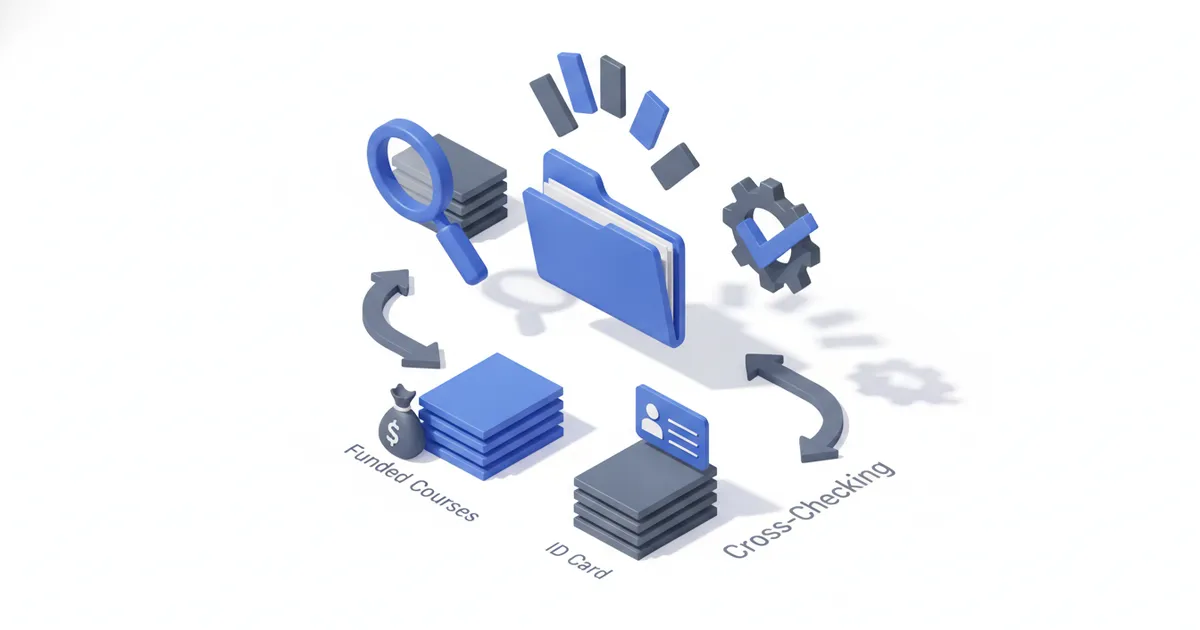
Training provider learner documents protect a funded enrolment only when the same facts agree across them: the name and date of birth on the ID, the Unique Student Identifier (USI), the enrolment form, the attendance record and the invoice sent to the funder. A student file where each paper looks fine but the dates or names disagree is the one a funding body or regulator pulls apart. This article lists which field is compared with which, what a mismatch looks like, and what the reviewer does next. A field comparison shows consistency. It does not prove a document is genuine.
Position as of 22 November 2026, for Australia. Funding rules differ by state, territory and program, so the funding contract or program guidelines you operate under are the controlling list. We did not verify a single national funded-training evidence rule for this article, so we describe the comparison logic and name only the mechanisms we could place.
What does a funder compare in a student file?
A funder compares three things: that the student is who the file says, that training happened on the claimed dates for the claimed hours, and that the amount invoiced matches what was approved. Each has a source document and a document you check it against. If either is missing, that point is unproven.
Ask the funding body for the required document list and the retention period in writing. Checklists from third parties, including this one, are a convenience, not the rule.
What does a USI check prove, and what does it not?
The USI is a reference number for a student's national training record, and the USI Registry System is where a provider checks that a number matches the student's details. The Australian Government's USI website explains how providers use it. A successful verification shows the number and the student's recorded details line up. It does not prove the ID presented at enrolment is genuine, and it says nothing about whether a given session took place.
So treat it as one comparison: the name and date of birth you hold on the enrolment form against what the USI check returns. A mismatch usually means a spelling variant or a wrong digit and is fixed with the student, not by overriding the record.
The cross-check matrix: field against field
Each row names a field, its source document, the second source it is compared with, a typical mismatch and the reviewer action.
| Field | Document A | Compared with | Mismatch looks like | Reviewer action |
|---|---|---|---|---|
| Full name | Driver licence, passport or other accepted ID | Enrolment form, USI check, funder claim | Name change, shortened given name | Get written confirmation, correct the record, keep the explanation |
| Date of birth | ID | Enrolment form, USI check | Day and month swapped | Correct before claiming; age can drive eligibility |
| USI | Student's USI | USI Registry check, enrolment | Transposed digit, number belongs to someone else | Re-verify with the student present, do not guess |
| Residential address | Proof of address | Enrolment form, funding eligibility form | State or postcode differs | Confirm the residency basis the program requires |
| Course and unit codes | Enrolment | Training plan, invoice | Unit invoiced that is not on the plan | Align plan and invoice before claiming |
| Start and end dates | Training plan | Attendance records, LMS logs | Attendance outside the enrolled period | Exclude out-of-period sessions, ask the trainer |
| Hours | Course schedule | Total of attendance, invoice | Hours invoiced exceed hours attended | Claim only supported hours and note the decision |
| Amount | Funding approval | Invoice | Invoice above approved amount | Reconcile with the funder first |
Ready to automate your checks?
Free pilot with your own documents. Results in 48h.
Request a free pilotHow do you match attendance, hours and invoices?
The attendance record or LMS log is the source; the invoice and any completion record derive from it, so their numbers must be traceable to it. Total hours per student, compare with the schedule, then with what you invoiced.
- Every attendance line belongs to a student on the enrolment list, with no blank lines signed later.
- Dates and times fall inside the enrolled period and at the approved location or platform.
- For online delivery, logins show the student named in the file, not a shared account.
- The trainer signs on the session date, not in a batch at term end.
On a mismatch there are three exits: correct a clear clerical error, reduce the claim to the supported amount, or escalate. Record the decision. For falsified credentials, see training certificate fraud detection.
What do staff and students actually ask?
"Is a signed attendance sheet enough if we are audited?" It is one source. It must agree with the enrolment, the training plan and the invoice. Identical handwriting across students is a flag, not proof.
"A student left halfway. What do we claim?" The hours actually attended and supported by the record. The completion or withdrawal record should show the real end date.
"The name on the ID is not the name on the USI. Which one wins?" Neither until the student confirms. Correct the record in writing and re-run the check.
How does the Privacy Act apply to student files?
Student files hold identity documents, so handle them as personal information under the Privacy Act 1988 and keep only what the funder or regulator requires. The OAIC sets out the Australian Privacy Principles, including security of personal information and limits on how long you keep it. Registered training organisations also answer to their regulator; the ASQA site explains its role and standards. Confirm which obligations apply to your organisation.
How do you run this at volume?
A file check produces three outputs: complete, consistent, and exceptions with a named owner. Run it before invoicing, not after a funder query. Sort exceptions by financial risk: hours, amounts and dates first, spellings last.
For comparable multi-document logic on another file type, see temp worker document verification before a first assignment and the industry verification guide.
CheckFile compares fields across the documents in a file (names, dates, identifiers) and flags where they disagree, so a reviewer starts from the exceptions. It does not decide funding eligibility and does not prove a document is authentic. See pricing, the security approach and the homepage.
FAQ
What documents should a training provider keep for a funded student?
Keep what your funding agreement names. Typically that means ID evidence, the enrolment form, USI verification, the training plan, attendance records and invoices.
What is the most common mismatch?
Hours and dates: hours invoiced above hours attended, and attendance outside the enrolled period.
Does a successful USI check prove the ID is genuine?
No. It shows the number and the recorded details line up. Authenticity needs a check of the ID itself or an official source.
How long should student files be kept?
The funding agreement and applicable law set the period. Confirm it in writing and do not keep personal information longer than needed.
Stay informed
Get our compliance insights and practical guides delivered to your inbox.