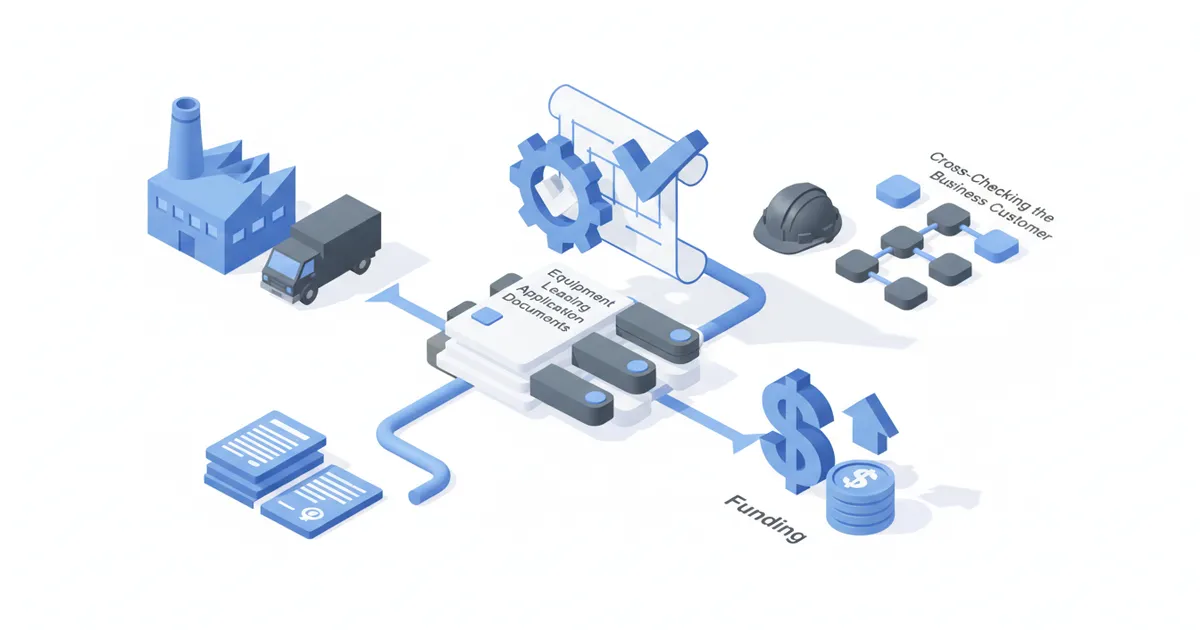
Equipment Leasing Application Documents: Cross-Checking the Business Customer Before Funding
Which field on which document to compare before an equipment lease funds in Australia: ASIC company extract, ABN Lookup, PPSR search, director ID, financials and tax records, bank details and supplier invoice.

Summarize this article with
 ChatGPT
 Claude
 Perplexity
 Gemini
 Grok
Equipment leasing application documents only protect a lessor if they are compared with each other and with an official register before the supplier is paid. A complete file can still be wrong: the company name on the application differs from the ASIC record, the signer is not a director, the direct debit account belongs to someone else. This guide lists the cross-checks field by field, what a mismatch looks like in an Australian file, and the reviewer's next step.
This article is for information only and is not legal or regulatory advice. Rules depend on the lessor's licensing and regulatory status. Confirm with counsel or your compliance team.
What an Australian lease file has to prove
A funding decision rests on four statements: the entity exists and is who it says it is, the person signing can bind it, it can pay, and the equipment exists and is what the lease schedule says. Each document supports one statement and the cross-check ties them together. For the full document list, see our guide to equipment leasing compliance and the article on document errors that get leasing files rejected.
A typical Australian application pack contains:
- finance application and director guarantee
- ASIC company extract (current and historical)
- ABN details and GST registration status
- latest financial statements and tax return, plus recent management accounts
- three to six months of business bank statements and direct debit request
- driver licence or passport for directors, owners and guarantors
- supplier quote or tax invoice, with serial numbers
- certificate of currency for insurance, naming the lessor
The cross-check matrix
| Field on document A | Compared with | Typical mismatch | Reviewer's next step |
|---|---|---|---|
| Company name and ACN on the application | ASIC company extract; ABN details; lease signature block | Trading name used as lessee; ACN and ABN belong to different entities; trust trustee not named | Contract in the exact registered name, with the trustee capacity where relevant; stop until the ACN, ABN and name resolve to one entity |
| ABN status and GST registration | ABN Lookup | ABN cancelled; GST not registered but invoices charge GST | Hold the file; ask the customer to explain and correct |
| Registered office and principal place of business | ASIC extract; delivery address on the supplier invoice | Registered office is an accountant's office; equipment installed elsewhere | Record the installation site separately; landlord consent for fixed equipment |
| Signer name and title | Current directors and secretary on the ASIC extract; company constitution; board resolution | Signer is an employee or a director who has ceased; sole director's execution misdescribed | Obtain a resolution or have a current director sign |
| Directors and shareholders on the application | IDs; ASIC share structure; director ID | Names, birth dates or holdings differ | Ask for an explanation and update the ownership record |
| Revenue and net assets on the application | Financial statements; tax return; BAS | Statements are 15 months old; stated turnover 35% above the return | Request interim accounts, BAS and bank statements for the gap |
| Account holder on the bank statement | Direct debit request; legal entity name | Account is a director's personal account or a related company's | Hold funding until the account matches, or document the exception |
| Equipment, serial number and price on the schedule | Supplier tax invoice | Model, price or GST differ; no serial number | Get a corrected tax invoice before paying the supplier |
| Supplier payment details | Supplier master record; supplier ABN Lookup entry | New BSB and account on a known supplier's invoice | Call the supplier on a number already on file before releasing funds |
| Insured, asset, value, interested party | Lease schedule | Supplier is the insured; lessor not noted; value below cost | Request an updated certificate of currency |
Entity identity: application against the register
ASIC holds the register of Australian companies; an ASIC company extract shows the registered name, ACN, status, registered office, officeholders and share structure (ASIC). The ABN Lookup service, run by the Australian Business Register, shows ABN status, GST registration, entity type and the entity name. The two registers are different: an ABN can exist without a company, and a company can have an ABN that no longer matches its name.
Three comparisons matter:
- The name, ACN and ABN on the application, lease and direct debit request must match the registers exactly. A business name is not a contracting party.
- The company status must be registered, and the ABN active. Deregistered or in external administration is a stop.
- Whether the customer is a trust. If so, the lessee should be the trustee in that capacity, and the trust deed and ABN need to match.
A register extract shows what was lodged and its status. It does not show that the person on your call is a director, and it does not make a PDF from the customer authentic. Run the search yourself.
PPSR search: what the public record says about the collateral
The Personal Property Securities Register (PPSR) is where security interests, including those of lessors under the Personal Property Securities Act 2009 (Cth), are registered; a search is both a risk check and a perfection step. Search by the lessee's ACN or ABN, and by serial number for serial-numbered goods. Compare with what the customer declared:
- a general security agreement over all present and after-acquired property
- registrations by other lessors or financiers against the same equipment
- registrations against the supplier that suggest the goods are already encumbered
A search lists registrations. It does not tell you whether the underlying debt is current. An undeclared general security interest needs an explanation and possibly a priority deed from the secured party. See ppsr.gov.au.
Signer authority and beneficial ownership
The signer check compares the name and title on the signature block with the current officeholders on the ASIC extract, and with the constitution and any resolution. Directors now also hold a director identification number; where your process allows, compare the number provided with the person's ID.
On ownership, compare the owners declared with IDs and the ASIC share structure. For companies with a layered structure, follow the chain up to the individuals.
Whether the AML/CTF Act 2006 applies to a lessor depends on whether it provides a designated service. AUSTRAC publishes guidance on who must enrol and what customer identification applies; check it and confirm with your compliance team before deciding which identification and beneficial ownership steps are mandatory. Personal information collected from directors and guarantors is covered by the Privacy Act 1988 and the Australian Privacy Principles, overseen by the OAIC.
For a deeper view of ownership chains, read our piece on company file and beneficial owner cross-checks.
Financial capacity: stated figures against statements and tax records
Many small proprietary companies do not lodge financial statements with ASIC, so the tax return, BAS and bank statements often carry the weight. Compare the year end, revenue, net assets and loans from directors with the application, then check the age. A 30 June year-end company applying in November has statements about four months old at best, which is good; one applying in June has statements almost twelve months old.
Compare revenue in the financials with the tax return and with the GST turnover on the BAS. Where the customer consents, ATO online services can show lodgment and account status, which is useful for tax debt.
What a mismatch looks like:
- Application shows $3.4 million in turnover, the return shows $2.4 million, no explanation of growth.
- BAS turnover is far below the stated sales.
- Financials show a large loan from a director not listed on the application.
The next step is a conversation and a request for evidence, not an automatic decline.
Bank account and direct debit request
The account holder name must match the lessee. Compare the statement header, direct debit request and application. BSB and account numbers should be identical on all three. A related company's account may reflect a group arrangement, but record and approve it, rather than find it after the first dishonoured debit.
Check continuity: opening balance equals prior closing balance, no date gaps, complete page count. Gaps call for the bank's original download.
The equipment: lease schedule against supplier invoice
Invoice errors and payment diversion both surface here. Compare:
- description, model and serial number on the tax invoice with the schedule
- price, GST and delivery charges
- supplier legal name, ABN and bank details with the supplier master record
- delivery location with the site declared by the customer
If the supplier's bank details changed, confirm by calling a number from your own records, not the invoice. Then check the certificate of currency: insured is the lessee, equipment described, sum insured at least equal to cost, cover in force by delivery, lessor noted as interested party. A delivery and acceptance certificate signed after installation should match the invoice date and serial number.
Questions business owners ask
Business owners on finance forums often ask the same things.
Why does the lessor want my driver licence when the Pty Ltd is the customer? Because the lessor has to know who controls the company and who is signing, and usually takes a director guarantee. The ID is compared with the ASIC extract and ownership records.
How old can my financials be? There is no universal rule. Many lessors want the latest year-end financials and, past nine to twelve months, management accounts or bank statements. That is lender policy, not law.
Why does the name on my bank account matter? The lessor draws payments by direct debit and needs to know the account belongs to the party that signed.
Running the cross-check consistently
Manual review works for a handful of files a week. At volume, consistency is the weak point: one analyst compares the ACN and ABN, another does not. A validation tool compares the same fields every time, flags name and date differences and queues exceptions for a person. It compares fields and dates across documents and registers. It does not prove a document is genuine, so keep your existing fraud controls.
See how this works for lessors on the financing and leasing page, check pricing, or read about file handling on our security page. Sector context is in the industry verification guide.
FAQ
What documents are required for an equipment lease application in Australia?
For a company: finance application, ASIC extract, ABN details, recent financials and tax return, bank statements, director and guarantor ID, supplier tax invoice and certificate of currency. Each is compared with another document or a register.
What is the most common mismatch in a lease file?
A business or trading name used instead of the registered company name, or an ABN that belongs to a different entity than the ACN. It looks minor, but the lease may name the wrong party.
Does an ASIC search confirm the customer is genuine?
It confirms the company exists, its status and officeholders. It does not confirm that the applicant is authorised or that supplied documents are authentic.
How do I verify a supplier's changed bank details?
Call the supplier on a number from your own records and confirm the new details before releasing funds.
When should a file be escalated rather than corrected?
When the company is deregistered or in external administration, the signer has no authority, or the bank account cannot be tied to the lessee. Name and date typos can be corrected with a signed amendment.
Stay informed
Get our compliance insights and practical guides delivered to your inbox.