CheckFile vs Jumio: complete comparison 2026
CheckFile vs Jumio comparison for Canada — FINTRAC, PCMLTFA, OSFI, PIPEDA compliance. Which document verification solution to choose in 2026?

Summarize this article with
 ChatGPT
 Claude
 Perplexity
 Gemini
 Grok
GrokCanadian businesses operating under PCMLTFA/FINTRAC reporting obligations, OSFI prudential requirements, and PIPEDA/Loi 25 privacy obligations face a compliance landscape that is substantively different from the FCA-regulated UK environment where Jumio built its core platform. The choice between CheckFile and Jumio requires assessing which solution addresses the realities of Canadian compliance — including provincial legal variation, bilingual requirements in Quebec, and a document mix that extends well beyond the passport-plus-selfie model common in consumer KYC.
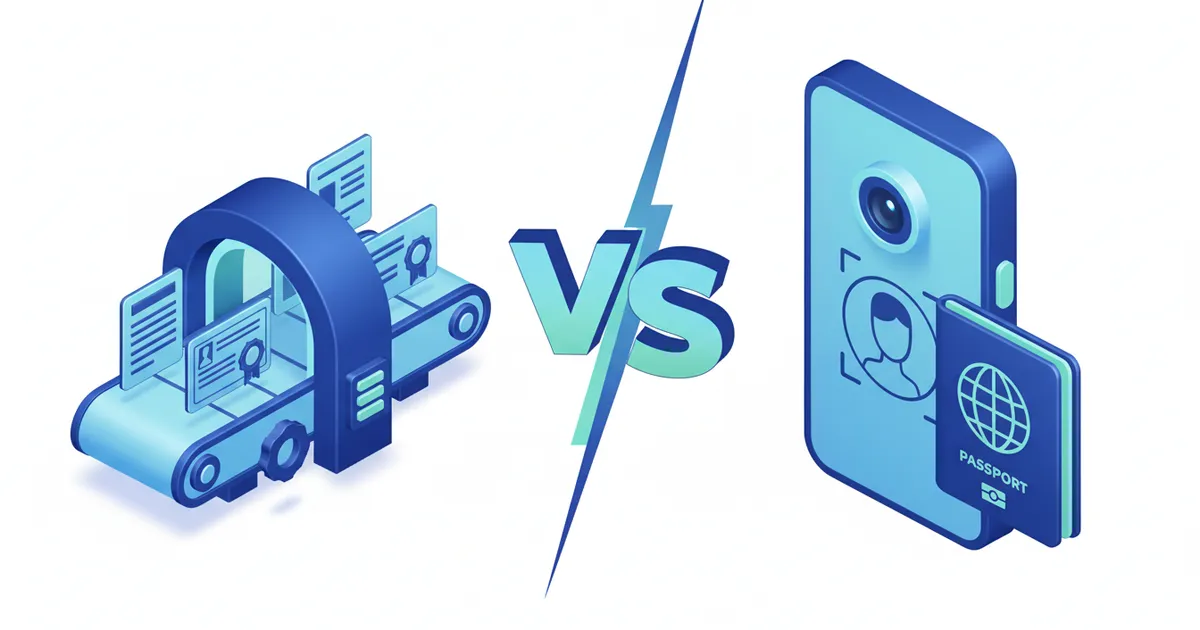
CheckFile is a broad-spectrum document verification engine processing 3,200+ document types — including Canadian passports, all provincial driver's licences, Permanent Resident Cards, SIN documentation, and corporate registry extracts — at approximately CAD $0.17 per document, at a latency compatible with interactive workflows. Jumio is an integrated digital identity platform combining document verification, facial biometrics, and AML screening, priced at CAD $2.70–$6.75 per complete verification, built primarily for high-volume individual KYC.
This article is for informational purposes only and does not constitute legal, financial, or regulatory advice. Regulatory references are accurate as of the publication date. Consult a qualified professional for guidance specific to your situation.
Comparison table: CheckFile vs Jumio
| Criterion | CheckFile | Jumio |
|---|---|---|
| OCR accuracy | Multi-language, tuned for production scans | Not published (biometrics-first) |
| Response time | Interactive-workflow latency | 15–60 seconds (with liveness) |
| Document types | 3,200+ (identity, commercial, HR, legal) | 5,000+ (primarily identity) |
| Jurisdictions covered | 32 | 200+ countries |
| Cost per verification | ~CAD $0.17 | CAD $2.70–$6.75 (depending on modules) |
| Fraud recall rate | Not published per supplier | Not published |
| False positives | Contextual scoring | Variable by configuration |
| SLA availability | 99.94% | 99.9% (published) |
| Data hosting | France (EU — native GDPR) | Multi-cloud AWS/Azure (EU optional) |
| Certifications | GDPR, PCMLTFA-aware | SOC 2 Type II, ISO 27001, PCI DSS |
| Canadian documents | Passport, all provincial licences, PR Card, SIN, corporate registry | Passport, provincial ID, PR Card |
| Integration time | 2–5 days | 4–12 weeks |
This table synthesises publicly available data from both vendors. The sections below provide the context necessary for an informed Canadian compliance decision.
Jumio: biometric-first identity verification
Jumio's KYX platform is a mature, enterprise-grade solution for individual identity verification with biometric authentication. The platform covers 5,000+ identity document types across 200+ countries and territories, including Canadian passports, provincial driver's licences, and Permanent Resident Cards. Its core workflow captures a document scan, a video selfie, and a liveness detection challenge — then compares the selfie to the document photograph biometrically.
Jumio holds iBeta Level 1 and Level 2 certifications for presentation attack detection, making it a recognised reference for anti-spoofing in financial services. The platform includes an AML screening module and a continuous monitoring capability marketed under the KYX (Know Your X) brand. It targets large enterprises: financial institutions, fintechs, and regulated onboarding platforms with high transaction volumes.
The platform is sold on enterprise contracts, which typically include volume discounts, dedicated support, and negotiated SLAs. Implementation requires engagement with a solutions team and integration timelines of 4–12 weeks, depending on activated modules and client architecture complexity.
Jumio's global coverage and biometric depth are genuine strengths. Its positioning, however, reflects the FCA-regulated UK and US financial services context where the product matured — a context that does not map directly onto the Canadian regulatory environment, as discussed in the compliance section below.
CheckFile: broad-spectrum document verification engine
CheckFile's core differentiation is document breadth: 3,200+ document types across 32 jurisdictions, including the full range of documents required for PCMLTFA customer due diligence in Canada. Supported Canadian documents include Canadian passports, all provincial and territorial driver's licences, Permanent Resident Cards, SIN documentation, Certificates of Incorporation issued by Corporations Canada, and provincial company registration extracts.
At approximately CAD $0.17 per document and a latency compatible with interactive workflows, CheckFile is sized for high-frequency, mixed-document workflows. Its OCR engine applies multi-language extraction tuned for the scan-quality variations of production documents across the full document base. Its detection method — multi-layer analysis of structure, metadata and cross-document consistency, with contextual scoring applied to false positives — applies across all supported document types, not only identity documents.
Data is hosted in France, within the EU, under the GDPR framework. No processing occurs outside the EU. For Canadian clients, this architecture requires a PIPEDA-compliant data transfer assessment (as discussed below), but eliminates concerns related to US Patriot Act access or opaque multi-region cloud routing. The 99.94% SLA supports inclusion in OSFI E-13 outsourcing risk assessments.
For a broader overview of the document verification market, see our document verification guide and identity verification solutions comparison.
Document and geographic coverage
The structural difference between the two platforms is most visible in document scope. Jumio excels at identity verification — one document, one person, one biometric confirmation. For an individual KYC flow requiring a passport plus selfie plus sanctions screening, Jumio provides a complete, integrated chain.
Full PCMLTFA customer due diligence requires more. Under FINTRAC guidance, reporting entities conducting business relationship formation or large cash transaction verification must collect and verify not just identity documents, but also, depending on the client type: corporate registration extracts, beneficial ownership declarations, articles of incorporation, and financial account documentation. For corporate clients, the 2023 CBCA amendments to Canada's beneficial ownership registry mean that incorporated entities must now provide verified beneficial owner information — information that arrives in documentary form, not biometric form.
CheckFile's coverage of SIN documentation, Certificates of Incorporation, provincial company registrations, and standard commercial documents (invoices, bank statements, contracts) addresses the full documentary dossier that PCMLTFA compliance requires. Jumio does not natively address these document types.
The jurisdictional difference is also relevant at the provincial level. Quebec's distinct legal framework — Civil Law system, French language requirements under the Charter of the French Language, and Loi 25 privacy obligations — creates compliance requirements that a globally standardised platform may not specifically address. CheckFile's document model is built at the jurisdiction level, accommodating provincial variation.
Pricing: ~CAD $0.17 per document versus enterprise contracts
The per-document cost difference between CheckFile and Jumio is approximately 16 to 40 times, depending on Jumio modules selected. CheckFile charges approximately CAD $0.17 per verified document, with no mandatory volume commitment and no minimum tier. Jumio charges CAD $2.70–$6.75 per complete verification, covering document capture, biometric match, liveness detection, and optional AML screening.
The difference reflects the scope of services delivered. Jumio bundles biometric infrastructure, facial comparison compute, liveness detection hardware certification, and AML data licences into a per-verification fee. CheckFile focuses on document extraction and validation, maintaining a low unit cost across a wide document range.
For a business processing 10,000 documents per month, the annual cost difference is material: approximately CAD $20,400 with CheckFile versus CAD $324,000–$810,000 with Jumio. This comparison is not perfectly like-for-like — Jumio delivers biometric capability that CheckFile does not — but for businesses whose verification workload consists primarily of commercial and corporate documents rather than individual biometric identity checks, the cost differential is structurally disproportionate to the value delivered.
To explore CheckFile's pricing model in detail, see our pricing.
Regulatory compliance in Canada: FINTRAC, PCMLTFA, OSFI, and PIPEDA
This section is the most important consideration for Canadian businesses choosing a document verification platform. The Canadian regulatory environment differs from the FCA framework in ways that materially affect platform selection.
PCMLTFA and FINTRAC obligations
The Proceeds of Crime (Money Laundering) and Terrorist Financing Act (PCMLTFA) is Canada's primary AML/ATF statute, administered by FINTRAC. Reporting entities — banks, credit unions, money services businesses, securities dealers, life insurance companies, real estate agents, lawyers, and accountants in prescribed circumstances — must file Large Cash Transaction Reports (LCTRs) for cash transactions exceeding CAD $10,000, Suspicious Transaction Reports (STRs) when there are reasonable grounds to suspect money laundering or terrorist financing, and Electronic Funds Transfer Reports (EFTRs) for international wire transfers above threshold.
PCMLTFA customer due diligence requires verification of identity using methods and sources prescribed by FINTRAC — not simply biometric selfie confirmation. For individual clients, acceptable identity verification methods include: government-issued photo ID (verified by document examination), credit file method, and dual-process method (two reliable sources). For corporate clients, verification of existence requires reviewing the certificate of incorporation or equivalent, articles of incorporation or similar documents, and — since the 2023 CBCA amendments — confirmation of beneficial ownership. CheckFile's coverage of these documentary sources supports a full PCMLTFA dossier. Jumio's identity-first model addresses the individual photo ID component well, but does not cover the corporate documentary record.
OSFI guidelines for federally regulated institutions
OSFI supervises federally regulated financial institutions (FRFIs) — federally chartered banks, trust companies, insurance companies, and pension plans. OSFI's AML/ATF guidelines require FRFIs to implement risk-based customer due diligence processes consistent with PCMLTFA obligations. OSFI's E-13 guideline on outsourcing risk further requires that third-party service providers used for material functions — which includes document verification for onboarding — be subject to due diligence assessments covering SLA guarantees, data security, business continuity, and regulatory examination access.
Both CheckFile (99.94% SLA) and Jumio (99.9% SLA) can be assessed under the E-13 framework. The key difference is data hosting jurisdiction: CheckFile's EU hosting requires a cross-border data flow assessment, while Jumio's multi-cloud architecture introduces questions about where biometric data is processed and stored. For OSFI-supervised institutions, these questions must be resolved in the outsourcing risk assessment regardless of which vendor is selected.
CBCA beneficial ownership registry (2023)
The 2023 amendments to the Canada Business Corporations Act introduced a beneficial ownership registry requiring federally incorporated corporations to maintain and disclose information about individuals with significant control. For businesses whose KYC workflows include corporate client onboarding, verifying and recording beneficial ownership information — including the documentary evidence — is now a distinct compliance obligation. CheckFile's support for Certificates of Incorporation and provincial company registration extracts directly supports this documentary verification step.
PIPEDA and Loi 25: privacy law implications
The Office of the Privacy Commissioner of Canada (OPC) enforces the Personal Information Protection and Electronic Documents Act (PIPEDA) at the federal level. PIPEDA is being modernised through Bill C-27 (the Consumer Privacy Protection Act), which at the time of publication was advancing through Parliament and, when enacted, will replace Part 1 of PIPEDA with more stringent obligations.
Under current PIPEDA principles, biometric data — including facial geometry derived from a selfie — is sensitive personal information requiring explicit consent, clear disclosure of purpose, and proportionality of collection. Jumio's biometric processing of facial data triggers these heightened consent and transparency requirements under PIPEDA, and under Loi 25 in Quebec.
Loi 25 (Loi modernisant des dispositions législatives en matière de protection des renseignements personnels), administered by the Commission d'accès à l'information du Québec (CAI), has been in effect since 2022–2023 and imposes stricter obligations than PIPEDA in several areas, including mandatory privacy impact assessments for new projects involving personal information, enhanced breach notification timelines, and additional rights for data subjects. Businesses operating in Quebec and using a biometric verification platform must ensure their Loi 25 privacy impact assessment addresses biometric data collection and cross-border transfer.
For CheckFile, the relevant privacy analysis concerns cross-border data transfers: data hosted in France is subject to EU GDPR. Canadian clients using EU-hosted processors must conduct a PIPEDA-compliant adequacy assessment of the EU framework. The EU has been generally recognised as providing adequate protection, but a formal assessment should be documented for OSFI-supervised institutions.
Technical integration: 2 days versus 4–12 weeks
CheckFile offers a documented REST API with a typical integration time of 2 to 5 days. Integration is a single API call per document: submit the file, receive a structured JSON response with extracted fields, validation results, and fraud signals. JavaScript and Python SDKs are available, along with webhooks for asynchronous processing. No biometric capture UI, no orchestration of a multi-step user-facing flow.
Jumio's integration is more extensive and more complex: REST API, native mobile SDKs for iOS and Android, embeddable iframe for web, and a comprehensive administration console. A complete Jumio deployment — including document capture, video selfie, liveness challenge, and AML screening in a single user flow — typically requires 4 to 12 weeks, according to vendor documentation and implementation feedback from the market.
For OSFI-supervised institutions with existing compliance architecture, a 2-to-5-day integration for document verification is operationally significant. The integration timeline difference also affects the cost of a pilot or proof of concept: CheckFile can be evaluated in production conditions within a week; a Jumio evaluation requires a materially longer commitment.
Document fraud detection
In the Canadian context, document fraud exposure includes falsified provincial driver's licences — which vary by province in format and security features — fraudulent SIN documents used in employment or financial fraud, manipulated Certificates of Incorporation, and altered bank statements submitted as proof of address or income. CheckFile's detection model covers this full range of Canadian document types.
Jumio's fraud detection targets identity-specific vectors: falsified identity documents, biometric spoofing using printed photographs or masks, and deepfake video attacks. Its iBeta Level 1 and Level 2 certifications for presentation attack detection are recognised benchmarks for liveness verification quality. For businesses whose primary fraud exposure is synthetic identity creation or account takeover using a real person's identity documents, Jumio's biometric layer addresses the relevant threat model.
The two approaches are complementary. A business exposed to both identity fraud (consumer account opening) and documentary fraud (corporate onboarding dossiers, supplier invoices, compliance certificates) may require both capabilities in its architecture.
When to choose CheckFile
CheckFile is the right choice for Canadian businesses when:
- Your PCMLTFA compliance workflow requires full dossier verification. FINTRAC customer due diligence for corporate clients requires documentary verification beyond a passport selfie — Certificates of Incorporation, beneficial ownership records, provincial registrations. CheckFile covers these document types natively.
- You verify SIN documentation, provincial driver's licences, or PR Cards at volume. CheckFile supports all provincial licence formats and Canadian identity documents, including documents that Jumio's identity-first model does not fully address.
- Unit cost is material. At approximately CAD $0.17 per document, CheckFile is sized for workflows processing thousands of mixed documents monthly. The cost difference versus Jumio is significant from approximately 500 monthly verifications.
- You need rapid integration for an existing compliance workflow. A REST API callable in 2 to 5 days, with no biometric flow to orchestrate, fits into existing case management and onboarding systems without a multi-week deployment project.
- Provincial coverage and bilingual document support matter. CheckFile's jurisdiction-level document model accommodates Quebec French-language documents and inter-provincial variations in driver's licence formats and corporate registration formats.
Start a free pilot to validate coverage against your specific Canadian document mix.
When to choose Jumio
Jumio is the right choice when:
- Your regulatory process explicitly requires biometric identity verification. If your compliance programme specifies a selfie-to-document biometric match with liveness detection — for example, a high-risk customer onboarding flow under enhanced due diligence (EDD) — Jumio provides a certified, integrated solution for that specific requirement.
- You are building a consumer-facing mobile application. Jumio's native iOS and Android SDKs and embedded liveness flow are designed for consumer onboarding experiences where frictionless user interaction is a product requirement.
- Your clientele is global. Coverage of 200+ countries and 5,000+ identity document types makes Jumio well-suited for Canadian businesses onboarding clients from a large number of international jurisdictions simultaneously.
- You have established KYC budget for enterprise identity infrastructure. At CAD $2.70–$6.75 per complete verification, Jumio is appropriately priced for high-value individual onboarding where biometric assurance justifies the cost — for example, regulated brokerage account opening or mortgage applications.
Verdict
Jumio and CheckFile serve different primary functions, and the Canadian regulatory context makes that distinction sharper than in other markets. Jumio is a complete digital identity platform with strong biometric capabilities. CheckFile is a broad-spectrum document verification engine with coverage that matches the documentary complexity of PCMLTFA compliance.
For Canadian businesses whose compliance obligations under PCMLTFA and FINTRAC require verification across the full range of individual and corporate documents — including SIN documentation, provincial licences, PR Cards, Certificates of Incorporation, and beneficial ownership records — CheckFile's document breadth and CAD $0.17 per document pricing represent a structurally better fit than a biometrics-first platform priced at enterprise identity verification rates.
For businesses that require biometric identity confirmation as a defined step in their CDD or EDD process, Jumio remains the market reference for that specific function. For organisations that need both — biometric confirmation for high-risk individual onboarding plus documentary verification for corporate dossiers — CheckFile and Jumio can operate as complementary layers in the same compliance workflow.
Frequently Asked Questions
Does CheckFile meet FINTRAC and PCMLTFA compliance requirements?
CheckFile supports the documentary verification methods prescribed by FINTRAC for customer identity verification — government-issued photo ID verification by document examination, corporate document verification (certificates of incorporation, articles of incorporation, provincial registrations), and beneficial ownership documentary records. The platform covers Canadian passports, all provincial driver's licences, Permanent Resident Cards, SIN documentation, and Certificates of Incorporation issued by Corporations Canada. CheckFile does not provide biometric liveness detection; if your PCMLTFA CDD programme requires a biometric selfie-to-document match, that component would need to be addressed separately.
How does CheckFile handle Canadian documents like SIN and provincial driver's licences?
CheckFile supports all provincial and territorial driver's licences across Canada, including the distinct format variations between provinces. SIN documentation and federal identity documents such as the Permanent Resident Card are supported within the 3,200+ document type base. For corporate documents, Certificates of Incorporation from Corporations Canada and provincial company registration extracts from provincial registries are supported. The document model is built at the jurisdiction level, which means Quebec French-language documents and inter-provincial format differences are accommodated rather than handled as edge cases.
Can CheckFile and Jumio be used together in a Canadian compliance workflow?
Yes. A layered architecture is common among organisations with both individual and corporate compliance requirements. Jumio handles biometric KYC for consumer onboarding — account opening, high-risk individual CDD or EDD flows — where a selfie plus liveness confirmation is required. CheckFile handles the documentary verification layer: corporate client dossiers, supplier onboarding, beneficial ownership document verification, proof of address, and commercial document validation. Both REST APIs integrate independently into the same workflow or case management system. This architecture allows each platform to operate within its core strength, avoiding the cost of applying a biometric pricing model to document types that do not require biometric confirmation.
Does Jumio's biometric processing comply with PIPEDA and Loi 25?
Jumio's biometric processing — capturing facial geometry from a video selfie — constitutes the collection of sensitive personal information under both PIPEDA and Loi 25. Under PIPEDA, this requires explicit informed consent, a clear disclosure of purpose and retention, and proportionality of collection relative to the stated need. Under Loi 25 in Quebec, additional requirements apply: a privacy impact assessment for new projects, enhanced breach notification obligations, and data subject rights that go beyond PIPEDA. Jumio's certifications (SOC 2 Type II, ISO 27001) attest to security process maturity, but Canadian businesses using Jumio for Quebec clients must ensure their Loi 25 privacy impact assessment specifically addresses biometric data collection and any cross-border transfers. Consult with a qualified privacy lawyer before deploying biometric identity verification for Quebec residents.
What is the total cost of ownership over 3 years?
For a business processing 10,000 documents per month, the estimated 3-year TCO is approximately CAD $61,200 with CheckFile (CAD $0.17 x 10,000 x 36 months) versus CAD $972,000–$2,430,000 with Jumio (CAD $2.70–$6.75 x 10,000 x 36 months). These estimates exclude integration costs — 2 to 5 days for CheckFile versus 4 to 12 weeks for Jumio — and ongoing support fees. For mixed workloads where only a portion of documents require biometric verification, a complementary architecture (Jumio for individual identity, CheckFile for corporate and commercial documents) can substantially reduce total cost compared to applying Jumio's pricing model across the full document volume.
EU data hosting, transparent per-document pricing.
Stay informed
Get our compliance insights and practical guides delivered to your inbox.