Loan Application Document Tampering: Edited Income Proofs
How loan application document tampering shows up in US consumer and small business files: the field-by-field cross-checks that expose edited income proofs and what to do next.

Summarize this article with
 ChatGPT
 Claude
 Perplexity
 Gemini
 Grok
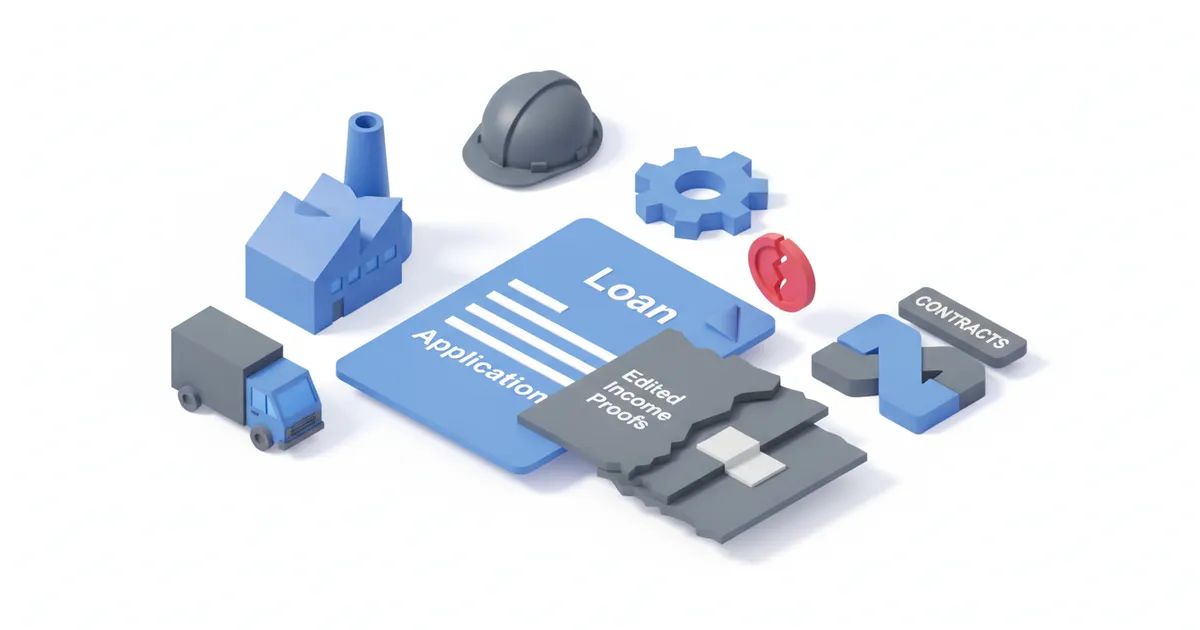
Loan application document tampering is rarely a perfect forgery. It is usually one edited number on one genuine document: a net pay raised on a pay stub, a closing balance rewritten on a bank statement, a gross receipts line changed in a business financial package. The edit survives a visual read. It rarely survives a comparison with a second document or an independent source, which is why the underwriter's job is to compare fields, not to stare at one PDF.
This article is for informational purposes only and does not constitute legal, financial, or regulatory advice. Regulatory references are accurate as of the publication date. Consult a qualified professional for guidance specific to your situation.
Where does tampering appear in a US loan file?
Tampering concentrates on the documents that drive the repayment decision: pay stubs, W-2s, bank statements, tax returns and, for businesses, profit and loss statements and balance sheets. Each is a file the applicant controls, so each can be edited with a free tool. One altered figure then has to stay consistent with everything else in the file, and that is where it breaks.
For loans secured by a dwelling, Regulation Z requires the creditor to make a reasonable, good-faith determination of ability to repay and to verify the income or assets it relies on using reasonably reliable third-party records (12 CFR 1026.43, CFPB). There is no equally general federal ability-to-repay rule for non-mortgage installment loans, so verification standards there come from the lender's own credit policy, its prudential regulator's expectations and, for small business loans, program rules such as those of the SBA.
On the applicant's side, knowingly making a false statement to influence a federally insured institution is a federal crime (18 U.S.C. § 1014), as is executing a scheme to defraud a financial institution (18 U.S.C. § 1344). The lender's duty to verify and the applicant's exposure meet in the same place: the documents.
| Document | Field most often edited | Why it pays off for the applicant |
|---|---|---|
| Pay stub | Net pay, gross pay, year-to-date, employer name | Raises declared affordability |
| W-2 | Box 1 wages, employer EIN | Supports a higher stated income |
| Bank statement | Deposits, ending balance, account holder | Shows income or reserves that are not there |
| Tax return | Total income, tax year | Supports a larger stated income |
| Business P&L / balance sheet | Gross receipts, net income, liabilities | Raises borrowing capacity |
| Employment verification letter | Salary, start date, position | Clears tenure or probation rules |
Which cross-checks expose an edited pay stub?
An edited pay stub is caught by comparing its net pay with the matching deposit on the bank statement. The stub says what was paid. The statement shows what arrived, on which date and from which originator name (often a payroll processor, not the employer). If the two disagree, one of them has been altered or the income is not what was declared.
The consumer file offers four reliable comparisons:
- Net pay vs the direct deposit. The stub net amount should match one ACH credit in the pay period. A stub showing $2,850 and a statement showing $2,215 is a mismatch to resolve, not a rounding issue. Remember that payroll processors use their own originator names, so match on amount and date first, name second.
- Year-to-date gross vs the W-2 and the tax record. Year-to-date gross on a final December stub should line up with W-2 Box 1 and Box 5 allowing for pre-tax deductions, and with wages on the return. Gaps point to an edited stub or an undeclared job change.
- Employer vs the register. The employer on the stub should exist and be in good standing in its Secretary of State business registry (a directory of state registries is at USA.gov). A dissolved entity, or a name that differs by one word from the registered one, is a flag.
- Statement arithmetic. Beginning balance plus deposits minus withdrawals must equal the ending balance, and one month's ending balance must equal the next month's beginning balance. Editors who change one deposit often forget the running balance.
For the detailed field mapping across stub, tax document and statement, see our guide to income consistency.
Can the IRS confirm the tax return itself?
Yes, with the applicant's consent. The IRS Income Verification Express Service (IVES) lets approved participants obtain tax transcripts for a third party, using a signed Form 4506-C, and the IRS only releases records with the taxpayer's consent (IRS, IVES).
A transcript is data from the IRS record, so comparing it with the return the applicant supplied exposes edited totals, a different filing status or a missing schedule. Three limits matter. A transcript confirms what was reported to the IRS, not whether the business or job generated that income today. It is not instant, so it fits better at final underwriting than at pre-qualification. And a transcript for one year says nothing about the pay stubs and statements from the current year, which still need the comparisons above.
Which cross-checks expose edited small business financials?
For a business loan, the strongest comparison is gross receipts on the P&L against deposits in the business bank account and against the filed return. The P&L describes a period chosen by the applicant, bank statements describe actual cash movement, and the return sits in between. A business cannot easily alter all three coherently.
| Check | Field A | Field B | What a mismatch looks like | Next step |
|---|---|---|---|---|
| Revenue | P&L gross receipts | Business account deposits, 12 months | Deposits well under stated receipts | Ask for sales tax filings and the ledger |
| Tax return | PDF supplied | IRS transcript via Form 4506-C | Different totals or schedules | Use the transcript as the reference |
| Entity status | Name and entity type on application | Secretary of State record | Entity not found, dissolved or different name | Pause, re-verify the legal entity |
| Ownership | Owners named on application | Operating agreement, state filings | Owner not listed | Re-run identity and ownership checks |
| Debts | Balance sheet notes payable | Bank statements, credit report | Payments with no matching liability | Add the debt, recompute debt service |
Our article on SME loan documents and their cross-checks goes through the field-by-field logic, and fake financial statements in business lending covers the balance sheet side. For SBA-guaranteed loans, remember that the applicant's certifications are made to a federal agency, so a false figure in the package is a problem beyond the lender's own credit policy.
Can account data pulled with consent replace the bank statement PDF?
In many files, yes, and it is the most robust answer to tampering: take the data from the bank instead of from a PDF the applicant could edit. Consumer-permissioned data aggregation is widely used by US lenders to read deposits directly. The federal rule that was meant to standardize this, the CFPB's Personal Financial Data Rights rule under Section 1033 of the Dodd-Frank Act, has been enjoined by a federal court and is being reconsidered, and the CFPB has sent a reconsideration proposal for review. As of this writing, do not assume the 2024 rule's access rights or its compliance dates apply; check the CFPB's Personal Financial Data Rights page for the current position.
Whatever the legal basis, the same two limits apply. The applicant chooses which accounts to connect, so a second, undisclosed account stays invisible. And transactions show what moved, not whether the income will last. Data pulled with consent replaces the statement check; it does not replace the affordability judgment. Handle the data under the Gramm-Leach-Bliley Act safeguards and applicable state privacy laws (FTC, GLBA guidance).
What does a mismatch look like, and what does the underwriter do?
A mismatch is any gap between two fields that should agree, beyond a tolerance you set in advance. Overtime, bonuses, tips and timing differences produce honest gaps, so the policy should define what counts as explainable before anyone is accused of anything.
- Classify the gap. Timing, rounding and one-off payments are explainable. A missing deposit, an unrecognizable originator or broken balance arithmetic are not.
- Request a source copy. Ask for the stub directly from the employer's payroll portal, a fresh statement downloaded from the bank, or an IRS transcript.
- Re-run the whole file. One edited document makes the others less trustworthy. Re-check identity, address and the other income evidence.
- Decide and record. Approve, reduce the amount or decline, with a documented explanation. If you decline or counteroffer, follow the notice requirements of the Equal Credit Opportunity Act and Regulation B (12 CFR Part 1002), and keep the stated reason accurate and consistent with the file.
- Escalate suspicion properly. Banks must file a Suspicious Activity Report generally within 30 calendar days of initial detection of facts that may constitute a basis for filing (31 CFR 1020.320), and SAR confidentiality means you must not tell the applicant that a report is being considered or filed. Non-bank lenders should check which BSA obligations apply to them.
What users ask about edited income proofs
People applying for credit often ask whether a lender can really tell that a pay stub was changed. In practice, the underwriter rarely looks at pixels first. The stub is compared with the bank deposits, the W-2 and the return, and the arithmetic usually gives the edit away before any technical analysis starts.
A second common question, from brokers and small lenders, is whether to check every file or only suspicious ones. Applying the same fixed comparisons to every file is cheaper than investigating after a charge-off, and it avoids singling out particular applicants, which also helps with fair lending. A fixed list also produces a record you can show an examiner.
A third question: what if the applicant simply made an honest mistake? Then the documented explanation and a source copy resolve it. The comparison does not accuse; it creates the point at which a person has to explain.
What these checks cannot do
A consistent forgery passes consistent checks. If an applicant edits the stub, the statement and the return with matching numbers, comparing them to each other finds nothing. That is why at least one comparison in the file should use a source the applicant does not control: an IRS transcript, a state registry record or account data pulled with consent.
Likewise, a registry lookup shows that an entity exists and what its filings say. It does not show that a PDF on your desk came from that entity.
How CheckFile fits into this
CheckFile compares fields across the documents in a file (names, amounts, dates, identifiers) and flags the ones that disagree, so the reviewer starts from the mismatch rather than from a blank page. For files where you suspect edited or generated documents, the document tampering detection page describes AI-generation signals as a complement to your existing controls. Lenders can see how this applies to financing and leasing files and to bank onboarding, and the broader sector context is in our industry verification guide. Pricing is on the tarifs page.
Frequently Asked Questions
What is loan application document tampering?
It is the alteration of a document supplied with a credit application, such as raising the net pay on a pay stub or rewriting a bank balance, so the applicant appears to qualify. Most cases involve a genuine document with one or two edited fields.
How do lenders detect edited income proofs?
They compare fields across documents: stub net pay against the bank deposit, year-to-date gross against the W-2 and tax return, employer against the state registry. Mismatches beyond a pre-set tolerance trigger a request for a source copy such as an IRS transcript.
Is Form 4506-C the same as asking for a tax return?
No. Form 4506-C, used through IVES, authorizes the IRS to send a transcript of what it has on record directly to the lender, with the taxpayer's signature. It is an independent source, whereas a return supplied by the applicant is a document they control.
Can cross-checks prove a document is authentic?
No. They show whether documents agree with each other and with independent sources. A coherent forgery across all documents can pass, so keep at least one source the applicant does not control.
What should an underwriter do on finding a mismatch?
Classify the gap, request a source copy, re-run the rest of the file, record the decision with an accurate adverse action reason if applicable, and escalate through your BSA and fraud reporting route if the gap looks deliberate, without tipping off the applicant.
Stay informed
Get our compliance insights and practical guides delivered to your inbox.